
Roseville Storm Damage
Winter atmospheric river storms in the Sacramento Valley frequently drive wind-driven rain into roof valleys and window flashings, requiring structural dry-out before roof tarping is finalized. Storm mitigation prioritizes immediate envelope stabilization like exterior tarping before running commercial air movers, preventing outdoor humidity from re-saturating interior cavities. Our dedicated specialists arrive equipped to safeguard your building integrity and eliminate hidden moisture.
Call (916) 555-0134 to set up an inspection.
Local Storm Recovery Specialists
Our crew delivers rapid response to protect residential structures whenever severe weather breaches building envelopes.
About 42% of housing units in Roseville, CA (24,389 of 58,435) were built since 2000, so a substantial share of the local stock is still on its original systems.
NOAA radar logged no hail signatures within about 15 miles of the city in recent years, so storm losses here come mainly from wind-driven rain and flash flooding rather than hail.
As homeowners often describe in local community discussions, pressurized water pipe breaks beneath concrete slab foundations trigger hot water anomalies, continuous meter movement, and structural foundation erosion risks.
To protect your property after a severe deluge, you can explore our comprehensive emergency water damage restoration services to halt hidden moisture intrusion.
Our Proven Storm Mitigation Protocol
During regional cloudbursts, Roseville waterways like Dry Creek and Secret Ravine can flash flood with minimal warning, rapidly overwhelming residential drainage systems. We execute a disciplined sequence to stabilize vulnerable perimeters, remove standing liquid, and thoroughly dehumidify structural elements before secondary decay takes hold.
- Immediate Envelope Stabilization. Severe storm conditions cause rooftop debris to dam rainwater, leading to sudden active ceiling leaks that threaten living spaces. Our crew immediately secures the building exterior with durable emergency tarps and weather-tight boards to stop ongoing rainwater penetration.
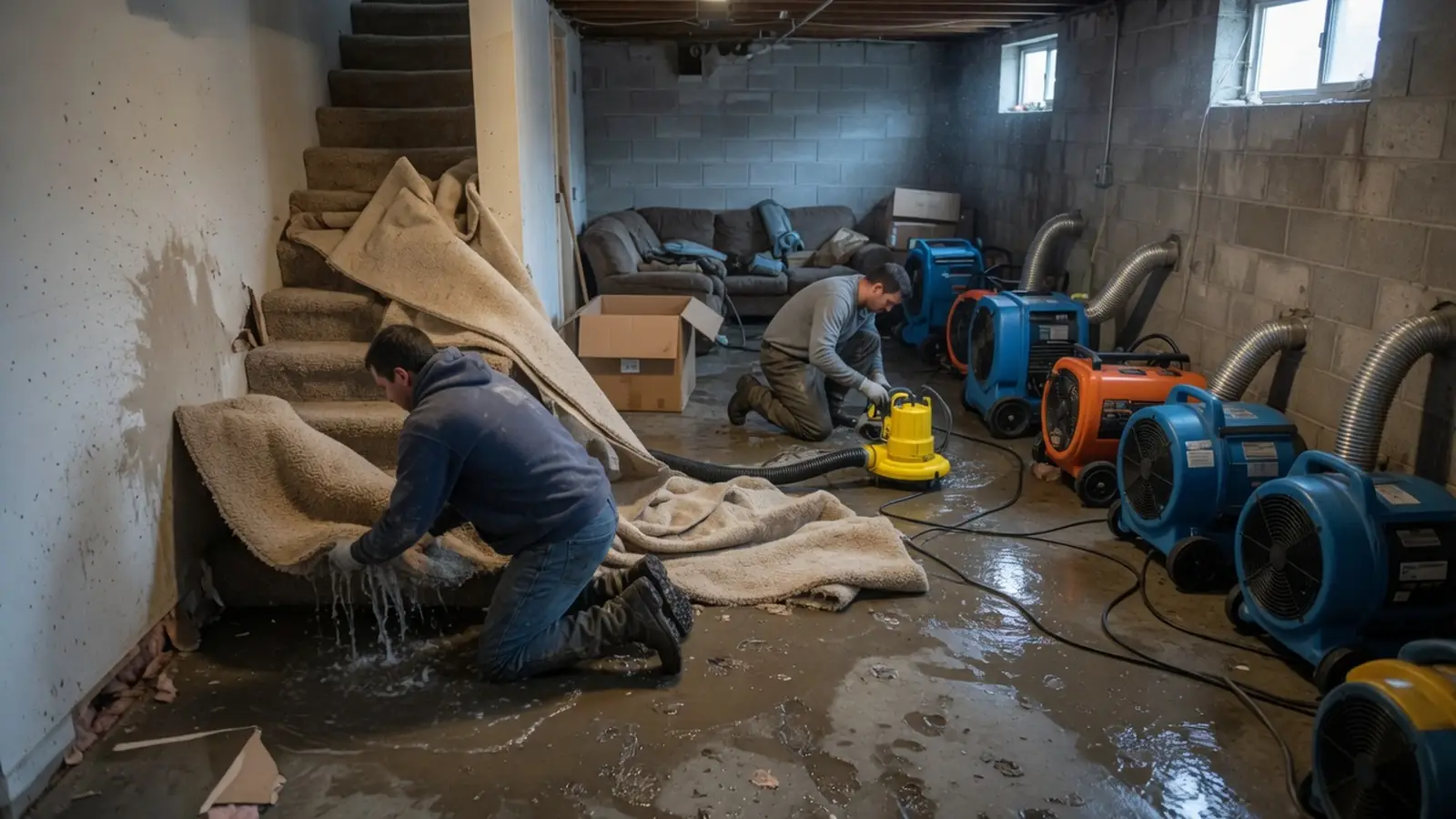
- Water Extraction & Debris Clearing. Heavy seasonal precipitation inundates crawlspaces with standing water, requiring rapid pumping and dedicated sump pump installation to prevent structural rot. You can schedule professional flood cleanup for standing water before moisture spreads further into subflooring.
- Thermal Imaging & Moisture Mapping. Wind-driven storm rain enters living areas through exterior stucco cracks, creating risks of concealed wall-cavity moisture and structural framing damage. Technicians deploy penetrating moisture meters and infrared cameras behind baseboards to locate saturated insulation without unnecessary demolition.
- Controlled Industrial Dehumidification. Commercial desiccant dehumidifiers and high-velocity air movers run continuously under closed conditions to pull residual moisture from wall studs and floor joists. Daily psychrometric logging confirms materials reach baseline dry standards before reconstruction begins.
Restoring Structural Integrity
A pattern echoed in regional trade discussions highlights how Placer County's expansive clay acts like a swelling sponge during deluges, putting lateral hydrostatic pressure on foundations and forcing water directly into crawl spaces. We stand behind our workmanship by testing every concealed cavity with precision moisture probes, and homeowners can learn more about our targeted mold remediation procedures to prevent microbial growth after severe weather.
Emergency Roof Tarping & Board-Up
Quick exterior sealing halts continuous rainwater ingress following severe wind, fallen branches, or compromised roof valleys. We secure weatherproof membranes tightly over vulnerable gaps to protect interior living areas.
Crawlspace Pumping & Drainage
Standing storm runoff pooled under your subfloor is pumped out using heavy-duty submersible systems. We dry framing timbers thoroughly and establish moisture barriers to prevent dry rot and persistent wood decay.
Structural Cavity Drying
Using directed warm airflow and industrial dehumidification, we extract trapped moisture from drywall cavities, sill plates, and subfloors. Comprehensive thermal monitoring ensures building components dry completely.
Our Approach To Storm Restoration
We respond swiftly with industrial drying systems to stabilize residential structures after harsh weather events, maintaining meticulous documentation for homeowner insurance claims.
- 10Zip Codes Served
- 5Service Areas
- 3Services Offered
Homeowners share their experiences after relying on our crew for rapid storm extraction, structural drying, and dedicated property recovery.
“When Saturday night rain started pouring through our ceiling, the crew picked up our call immediately and arrived with tarps within an hour. They secured the roof leak in pitch darkness and halted the water before it ruined our living room floor. Their weekend responsiveness saved us from catastrophic structural damage.”
Marcus B.
“Every evening before heading out, the crew swept our hallways, coiled all power cables, and neatly cordoned off the containment zones. We never had to step over damp debris or misplaced equipment during the entire drying process. That tidy approach made living through a disaster much easier.”
Elena R.
“Detailed text updates and moisture meter photos arrived on my phone every single morning without me ever having to ask. The team documented daily psychrometric drops so clearly that our insurance adjuster approved the work without delay. Having constant visibility into the drying progress gave our family immense peace of mind.”
Derek K.
“Instead of tearing out our entire wood subfloor, the technician demonstrated how targeted cavity injection drying could safely salvage the existing framing. They explained which insulation batts truly required replacement and which could be preserved, saving us substantial rebuild expenses. The crew genuinely prioritized durability and cost-effective solutions.”
Patricia H.
Frequently Asked Questions
How quickly should storm damage mitigation begin after rainwater enters a home?
Storm mitigation should begin within 24 to 48 hours to prevent microbial growth, structural wood weakening, and irreversible subfloor swelling. Immediate water removal and exterior tarping stabilize the building envelope, preventing high outdoor humidity from re-saturating wall cavities.
Does homeowner insurance typically cover structural drying and roof tarping after a storm?
Most standard homeowner policies cover emergency tarping and drying when water intrusion results from sudden, violent storm occurrences. Insurers require policyholders to take reasonable steps to prevent secondary water damage, making prompt structural stabilization and psychrometric drying logs essential for claim reimbursement.
How long does it usually take to dry out wall cavities and framing after storm flooding?
Complete structural drying typically requires three to five days using industrial desiccant dehumidifiers and high-velocity air movers. Technicians track moisture readings daily against dry standard baselines, keeping equipment running until internal wood framing reaches safe moisture equilibrium.
Can wet insulation and drywall be dried in place after storm water intrusion?
Wet drywall can occasionally be dried in place if clean rainwater penetrated briefly, but saturated fiberglass insulation must be removed. Saturated batting loses its thermal rating and compresses against wall studs, trapping hidden moisture that fosters mold if not promptly extracted.
What steps prevent mold from developing inside crawlspaces after heavy seasonal rainfall?
Immediate standing water extraction paired with high-volume air circulation and commercial dehumidification stops mold spores from colonizing. Installing dedicated submersible sump pumps and heavy polyethylene vapor barriers prevents damp ground soil from continually evaporating moisture into subfloor joists.